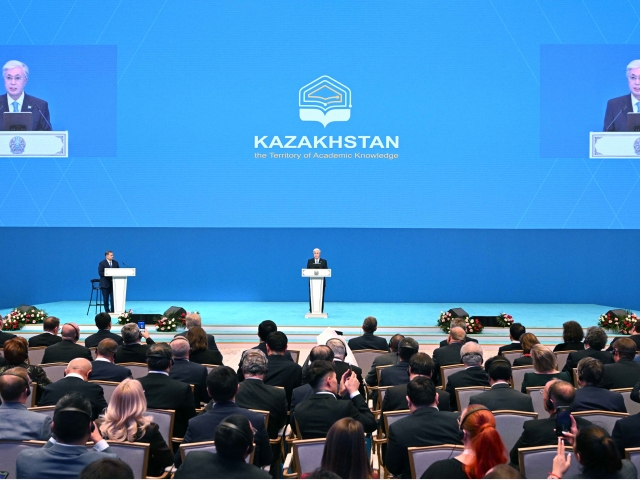
International Forum of Strategic Partners in Education and Science Held with the Participation of the President of Kazakhstan
The International Forum of Strategic Partners “Kazakhstan – Territory of Academic Knowledge” was held in Astana with the participation of the President of the Republic of Kazakhstan, Kassym-Jomart Tokayev.
During the forum, the Head of State emphasized that education and science are key strategic spheres that transcend borders and unite nations. According to him, the forum itself serves as vivid proof of this idea.
“This is indeed a very important event, a unique platform where valuable ideas are expressed and forecasts for the development of global education and science are formulated. Since yesterday, meetings of leaders and representatives of leading universities from around the world have been taking place in Astana, with an active exchange of opinions. International scientists and experts are discussing relevant issues in our capital today. Prestigious academic leaders of world universities are sharing their profound insights with us. I express my sincere gratitude to all of you,” said Kassym-Jomart Tokayev.
The Minister of Science and Higher Education of Kazakhstan, Sayasat Nurbek, presented a number of specific measures taken by the Ministry aimed at a deep transformation of both the national and global educational ecosystem.
“A network of 40 branches of foreign universities is being established in Kazakhstan, 85% of which focus on high-tech fields such as artificial intelligence, computer engineering, cybersecurity, natural and technical sciences, nuclear physics, and other in-demand specialties. This allows students to receive international education within the country. University branches also attract investment and promote academic tourism. Today, 31,500 international students are studying in Kazakhstan — a historic record. For the first time, the number of students from Asia has exceeded that of students from the CIS. By 2029, we plan to increase their number to 100,000,” said Sayasat Nurbek.
Within the framework of the forum, it was noted that a Council of Strategic Partners had been established to ensure institutional cooperation and joint decision-making on key issues. To date, three meetings of the Council have been held.
Nunzio Quacquarelli, President and Founder of Quacquarelli Symonds (QS, UK), spoke about the impact of artificial intelligence on the labor market and noted the growing number of Kazakh universities entering QS rankings. He highlighted Kazakhstan’s significant progress in internationalization and scientific competitiveness. Moreover, five Kazakh universities have entered the list of the world’s best higher education institutions compiled by Times Higher Education (THE).
“QS intends to cooperate with Kazakhstan in developing a model for forecasting future professions and fostering an economy based on knowledge and innovation,” he stated.
Professor Wendy Larner, President of Cardiff University (UK), underlined the strategic importance of the partnership with Kazakhstan in the fields of education and artificial intelligence. She noted that Cardiff is the first university from the prestigious Russell Group to open a campus in Kazakhstan. The new Cardiff University Kazakhstan campus will serve as a platform for training future specialists in AI, biotechnology, and medicine.
Professor Peng Duan, President of the Beijing Language and Culture University (BLCU), highlighted the importance of education as a tool for strengthening trust between nations. He emphasized the significance of opening a BLCU branch at Astana International University—the first center of Chinese language education in Central Asia.
“Language and culture are the keys to mutual understanding and the diplomacy of trust between countries,” the professor stressed.
Anatoly Torkunov, Rector of the Moscow State Institute of International Relations (MGIMO), noted that Kazakhstan is a reliable partner and ally for Russia in the field of education. He emphasized the strategic importance of opening an MGIMO branch in Astana and expressed confidence that this would become an important step toward building a unified educational space and training future leaders.
Yerbol Isakayev, Rector of M. Kozybayev North Kazakhstan University, presented the experience of modernizing academic partnerships with the University of Arizona, which led to joint research in the field of agriculture. He also demonstrated how a regional university can achieve academic and research excellence.
In his concluding remarks, President Kassym-Jomart Tokayev thanked all forum participants for their meaningful speeches, constructive suggestions, and high interest in cooperation. The Head of State emphasized that Kazakhstan will continue to comprehensively develop its universities.
“Strong universities are true factories of the future, where ideas are born, barriers are overcome, and the outlines of a fairer and more harmonious world are formed. Universities strengthen trust and cooperation among nations, promoting the diplomacy of values. Student communities, research associations, and academic partnerships formed within universities become drivers of change not only in the scientific and educational spheres but also in the economy, public life, and even politics.
The outstanding son of the Kazakh people, academician Kanysh Satpayev, once said: ‘A true scientist dedicates his entire life to serving his people and all humanity.’ Indeed, the main mission of science is to serve humanity. I firmly believe that scientific achievements should contribute to the progress of the global community. Science and knowledge are powerful tools that become more advanced as they develop, unlocking limitless possibilities. I am confident that cooperation in this area will greatly expand Kazakhstan’s educational and scientific horizons and give a strong impetus to the development of academic diplomacy,” said the President.
In conclusion, the President noted that Kazakhstan has many talented, capable, and intelligent citizens. He stressed that the reforms being carried out are a key path toward the nation’s bright future. He also emphasized that Kazakhstan will continue to build a Just, Clean, Safe, and Strong state based on education and science. Special attention was given to the contribution of strategic partners and educational and scientific institutions that help broaden the horizons of science and strengthen the potential of the nation’s main wealth — human capital.
The forum was attended by leaders of foreign partner universities, representatives of international accreditation and ranking agencies, as well as members of the diplomatic corps. Other speakers included Kim Song Kyung, Chair of the Board of Trustees of the Woosong Educational Foundation, Vladimir Shevchenko, Rector of MEPhI, Ben Nelson, President of Minerva University, and Elchin Babayev, Rector of Baku State University.