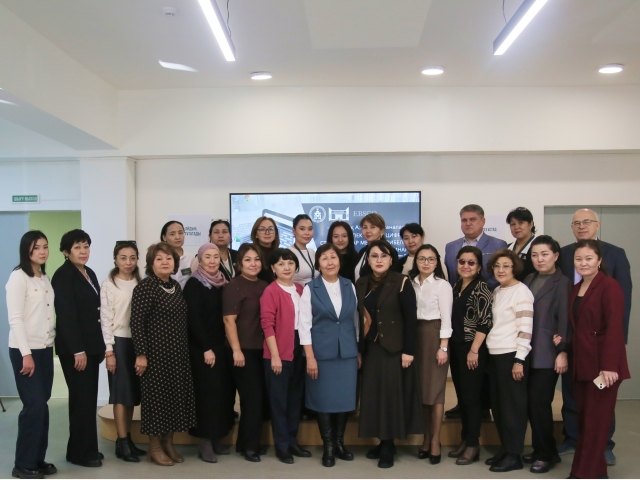
On November 26, 2025, the Seraly Kaniyev Scientific Library of the Kazakh National Women’s Teacher Training University hosted the seminar “Central Asian Libraries: Promising Digital Strategies and Practices”, organized by the library and EBSCO, with the support of the IFLA Regional Committee for Asia and Oceania.
Leading library specialists, representatives of information companies, and researchers took part in the seminar. Participants discussed trends in the development of new technologies shaping the digital landscape of modern libraries. The focus was on EBSCO tools, new cataloging standards, the BIBFRAME model, artificial intelligence capabilities, and prospects for corporate collaboration among university libraries.
Alexander Rytov, EBSCO’s representative for Central Asian countries, presented an overview of the platform’s digital services and highlighted current cataloging practices. In his presentation, he also covered libraries’ transition to the BIBFRAME model and linked data, emphasizing the advantages of the new standard over MARC. A separate segment of Rytov’s talk was devoted to practical aspects of configuring EDS for the humanities and opportunities for integrating the service with institutional repositories. In addition, he demonstrated new features on the EBSCOhost platform related to the implementation of artificial intelligence tools.
Asem Otegenova, Director of the Library, shared practical experience in using the EBSCO Discovery system in an academic library, emphasizing the service’s ability to enhance the quality and speed of information retrieval.
The important international context of libraries’ digital transformation was highlighted in a presentation by Deputy Director and representative of the IFLA Regional Committee for Asia and Oceania, Petr Lapo. He provided an overview of global practices in applying artificial intelligence technologies in library work. He also addressed issues of corporate collaboration among university libraries in Kazakhstan, outlining prospects for joint initiatives and network-based cooperation.
The seminar became a platform for professional exchange and discussion of key directions in the digital transformation of libraries in the region. Following the event, the organizers emphasized the need to expand digital practices, strengthen interlibrary cooperation, and implement joint initiatives. At the conclusion, seminar participants received certificates from EBSCO.