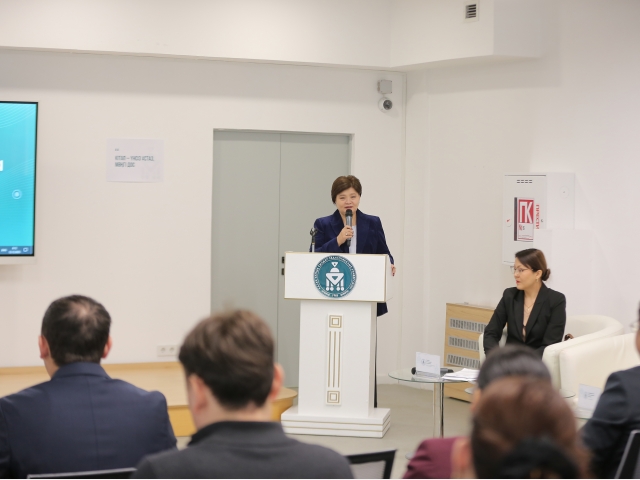
On December 12, 2025, at the Kazakh National Women’s Teacher Training University (QyzPU), in cooperation with the National Academy of Sciences of the Republic of Kazakhstan under the President of the RK, the section “Intellectual Potential of the Country” in the field of Natural Sciences took place as part of the II International Congress of Young Scientists.
The main goal of the event was to strengthen scientific cooperation between young researchers from Kazakhstan and abroad, as well as to create an effective platform for discussing the results of scientific research. Around 20 speakers participated in the congress, including 10 young scientists from Armenia, China, and Turkey.
At the opening of the event, the Chairperson of the Board – Rector of QyzPU, Beibitkul Karimova, delivered a welcoming speech and emphasized the significance of the Congress.
"This Congress contributes to the strengthening of international scientific cooperation and opens the way to new ideas and research directions. In the context of increasing global changes and rapid technological progress, science becomes a key mechanism for the country’s economic growth, improving the quality of education, and developing innovative potential. Therefore, the pursuits of young researchers, their innovative thinking, and bold approaches are the guarantee of Kazakhstan’s development in the coming decades," noted Beibitkul Sarsemkhanovna.
Panel sessions were held on the topics “Natural Sciences: Nanomaterials and Green Energy” and “Intelligent Solutions: Innovation, Sustainability, and Mathematical Modeling.” Young researchers from Kazakhstan and abroad presented significant results of their scientific work.
Professor of QyzPU and Doctor of Chemical Sciences, Mukhametkali Mataev, in his speech emphasized the importance of international cooperation, sharing laboratory experience, and promoting innovative projects in the modern scientific environment.
"Today, young scientists are provided with broad opportunities. Funded research projects, international internships, and the '500 Scientists' program – all these contribute to attracting youth to science. Researchers work in international laboratories and improve their professional qualifications. The country needs innovative and advanced projects, and at this Congress, it is important to identify such initiatives in priority areas. Our scientists can strengthen their potential through collaboration with foreign colleagues. This is important," noted the professor.
The Congress promotes the development of innovative solutions, strengthens interdisciplinary connections, and creates conditions for scientific cooperation. Interaction among scientists ensures the emergence of new research and significant scientific results.
According to PhD in Chemical Sciences and member of the Presidium of the Council of Young Scientists at the National Academy of Sciences of the RK, Nurgali Akylbekov, nanotechnology is a promising field offering great opportunities.
"Today, significant changes are taking place in science. In chemistry and physics, as well as in other fields, the area of nanotechnology is actively developing, already widely applied, and has high growth potential. The collaboration of domestic and foreign scientists, and the exchange of opinions across different fields, contributes to strengthening interdisciplinary connections," he noted.