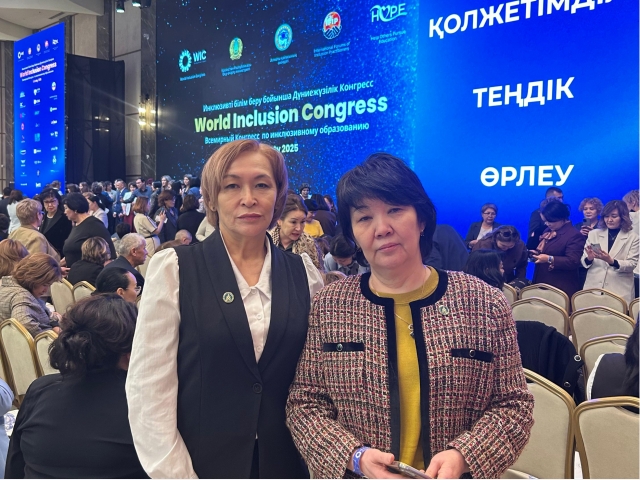
The first World Inclusion Congress (WIC 2025) concluded its work in Almaty. From October 15 to 17, the international forum brought together about 1,400 experts, educators, government and public organization representatives, and education leaders from 40 countries. Participants discussed ways to build a quality, safe, and accessible education system for all children.
The main outcome of the Congress was the adoption of the Almaty Declaration, which will be submitted to UNESCO. The document outlines key directions for the development of inclusive education, including the integration of inclusive practices into general education systems, the use of EdTech and artificial intelligence, ensuring equal access to knowledge, and creating international platforms for collaboration. The Congress also discussed the potential of digital technologies and AI as effective tools for promoting inclusion.
Representatives of the Kazakh National Women’s Teacher Training University (QyzPU) took an active part in this large-scale event.
- Gulzhan Orazayeva, Director of the Institute of Pedagogy and Psychology, presented the university’s experience in the field of inclusive education and spoke about strategies for training special education professionals.
- Dr. Gulmira Topanova, PhD, Head of the Psychology Education Program, shared her insights on mental health in the digital age.
- Laura Shotybayeva, lecturer at the Department of Special Pedagogy, presented a comparative analysis of assessment systems for special educational needs in Kazakhstan and other countries.
The WIC 2025 Congress served not only as a platform for exchanging experience in inclusive education but also reaffirmed that Kazakhstan holds a significant place on the global map of innovation and educational trends.